

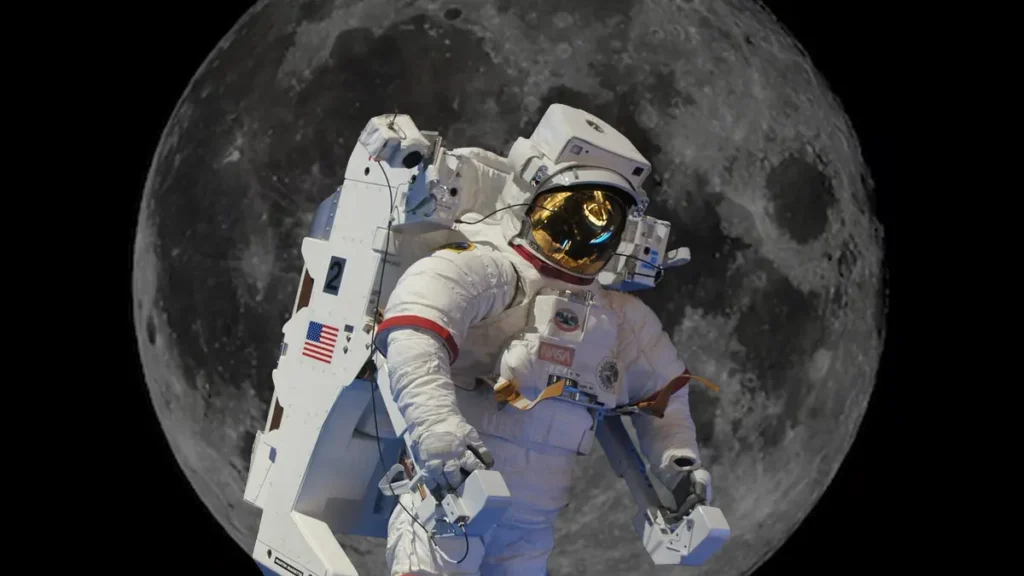
WASHINGTON D.C. — NASA is no longer speaking of lunar outposts in the abstract. Under the leadership of Administrator Jared Isaacman, the space agency on Tuesday solidified a definitive roadmap for a permanent human presence on the moon within the decade, coupled with an ambitious plan to launch a nuclear-propelled spacecraft to Mars by late 2028.
“This is the moment where we should all start believing again,” Isaacman said during a keynote address to aerospace leaders and members of Congress. “NASA once changed everything, and we’re going to do it again.”
The Isaacman Era: Stability Amidst Downsizing
Isaacman, a billionaire entrepreneur and two-time orbit traveler, has brought a private-sector urgency to an agency currently grappling with a 20% staff reduction under the Trump administration’s federal downsizing. Despite the internal turmoil, Isaacman has secured buy-in from key aerospace players, pivoting the Artemis program toward faster, more simplified mission architectures.
A major strategic shift includes the overhaul of Artemis III. Originally a moon landing attempt, the mission—now slated for 2027—will remain in Earth orbit to practice critical docking maneuvers between the Orion capsule and lunar landers developed by SpaceX and Blue Origin. This sets the stage for dual moon landing attempts during Artemis IV and V in 2028.
A Three-Phase Lunar Civilization
NASA’s blueprint for the Moon Base, estimated to cost $30 billion, will proceed in three distinct stages:
- The Templated Approach: Utilizing small robotic landers and surface vehicles to establish communication and scientific networks.
- Semi-Habitable Infrastructure: Developing facilities for regular, short-term astronaut visits.
- Permanent Outpost: Constructing full-scale habitats and nuclear power plants capable of supporting 150,000 kilograms of surface payload.
To fund this, NASA has suspended work on the Gateway lunar space station, redirecting its $10 billion budget and technical expertise directly to the lunar surface.
The Nuclear Leap to Mars
Perhaps the most technologically daring announcement is the SR-1 Freedom (Space Reactor-1), a robotic spacecraft powered by a nuclear fission reactor.
Originally part of the Gateway project, the station’s power and propulsion elements are being repurposed into a nuclear engine. While the initial reactor is a technology demonstrator, it aims to prove that nuclear propulsion can significantly shorten the hazardous journey to Mars. Upon arrival in 2028, SR-1 Freedom will deploy three advanced robotic helicopters to the Martian surface.
The New Space Race: USA vs. China
The accelerated timeline is fueled by more than just scientific curiosity; it is a geopolitical necessity. With China aiming for a 2030 lunar landing, NASA’s 2028 target leaves little room for error.
“The difference between success and failure will be measured in months, not years,” Isaacman warned. “China is a real geopolitical rival challenging American leadership in the high ground of space. They may be early, and recent history suggests we might be late.”