
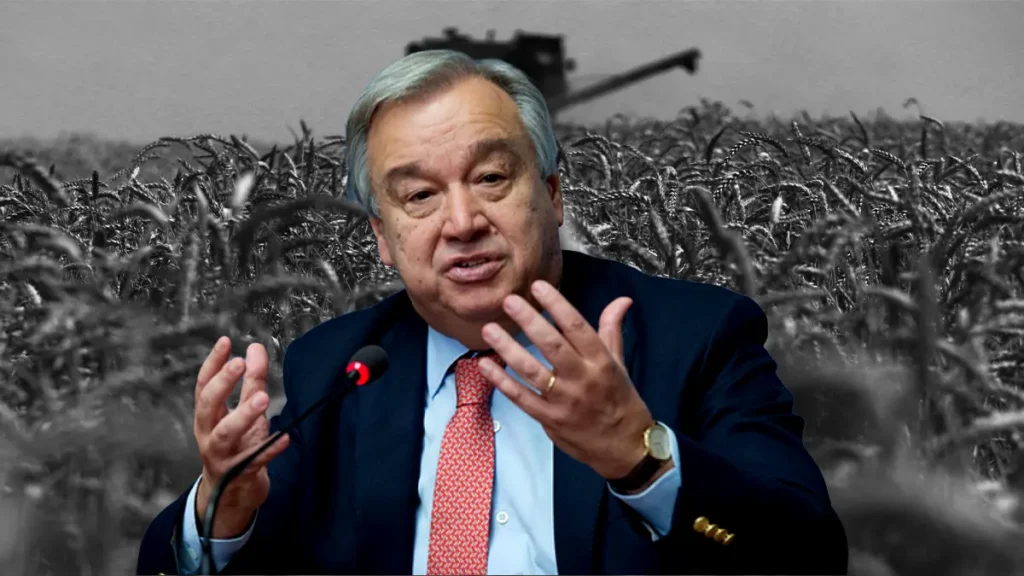
NEW YORK — United Nations Secretary-General António Guterres issued a stark warning on Wednesday, stating that the world faces an imminent hunger crisis as the escalating conflict in Iran chokes off global fertilizer supplies during a critical planting season.
“Without fertilizer today, there will be no food tomorrow,” Guterres told reporters at the UN Headquarters. The Secretary-General emphasized that the war, ignited by joint U.S.-Israeli strikes, has created a “perfect storm” of soaring energy costs and blocked trade routes, leaving developing nations on the brink of catastrophe.
The Hormuz Choke Point: A Global Artery Under Siege
The closure of the Strait of Hormuz has effectively severed one of the world’s most vital agricultural arteries. According to UNCTAD data, approximately one-third of global seaborne fertilizer trade passes through this narrow corridor.
In 2024 alone, 16 million tons of fertilizer—primarily urea and phosphates essential for crop yields—transited the strait. With the route now compromised, global supply has plummeted, sending international urea prices skyrocketing by 40% since the conflict began.
Protectionism in Beijing and Moscow
Adding to the volatility, the world’s largest producers, China and Russia, have moved to secure domestic supplies through strict export curbs.
- China: Reports indicate that Beijing has restricted exports of nitrogen-potassium blends and phosphates to stabilize internal prices. Analysts at BMI suggest these restrictions, expected to last until at least August, could reduce China’s export volume by up to 75%, or 40 million metric tons.
- Russia: The Kremlin has suspended all ammonium nitrate exports until late April 2026. As Russia accounts for nearly 25% of the world’s ammonium nitrate production, this temporary ban has sent shockwaves through global markets already reeling from the loss of 24% of the world’s ammonia supply typically sourced through the Gulf.
Global Response and the Burden on Farmers
From the American Midwest to the heart of Europe, the impact is being felt directly by producers. In the U.S., where 15% of fertilizer imports originate from the Middle East, farmers report nearly a 40% increase in seasonal costs.
“This is a matter of national security,” said Zippy Duvall, President of the American Farm Bureau Federation (AFBF). “Many of our members simply cannot secure the nutrients needed for the spring planting.”
In response, Washington is reportedly scouting alternative suppliers in Morocco and Venezuela, while the European Union, led by Kallas, is advocating for a “safe corridor” in the Strait of Hormuz specifically for food and agricultural goods. However, analysts warn that these diplomatic efforts may be too little, too late to prevent a significant drop in global crop yields this year.